Wednesday, October 31, 2012

My Urn Awaits

On this night when we traditionally laugh at our fears -- of goblins and ghouls, of things that go bump in the night, of our unleashed selves at that wild costume party -- I am home alone in my dark old house, about to build a fire, watch a scary movie, and contemplate Death with love and humor.

Tonight, through ritual celebrations, people of all ages in our death-fearing culture get to relax a little, and take the tiniest peek at the monster under the bed.

Perhaps what we fear is Life, not Death. If we surrender to Life and live in each precious moment, we have to let go, over and over, and damn, that can hurt.  It's often easier to dull the senses through distractions, but my wish is to completely wake up to the beauty and pain of it all.

Pausing the stream of mental chatter and tapping into essential being is what I have been seeking and studying here for years, especially recently. I want to enter into all the moments of my life, not just skate along the surface in the commentary of my mind and wonder what the hell happened when it's over.

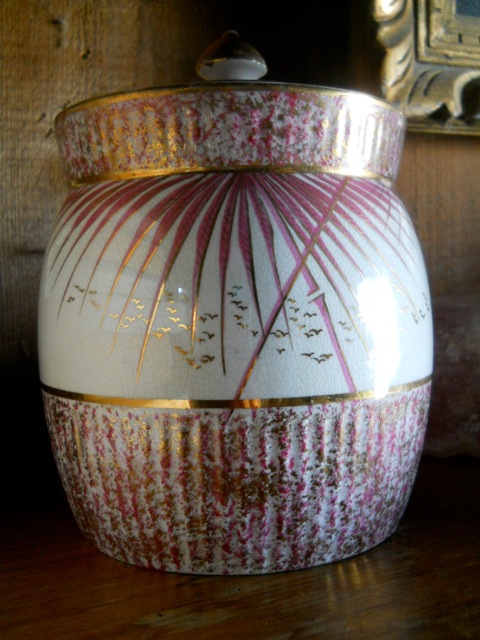
Recently I was given a lovely gift from a couple who has faced Death in many ways. Awareness of our end-date adds a certain spice to each breath we take, and while my friends did not intend that I make this simple urn my final resting place, I think it is a perfect fit for my cremains.

So my very own pink and cream ceramic urn, with gold leaf details and a flock of tiny birds flying behind a fan of pink bamboo, sits on top of my dresser and waits. The dash of grief I feel when I look at it each day is gently teaching me to accept, not fear, my death. A note inside states that it is the future home of Linda Sonrisa Rowland-Jones.

"We love beauty because the mind stops," says Eckhart Tolle, and the wonder we feel in Big Sur brings flashes of serenity, so that we can sense our ability to blossom. The ocean, the mountains, the night sky, birdsong, storms and sunsets, flora and fauna, and the full moon on Halloween combine to create a world whose beauty makes me forget that Big Sur (and so much more) will outlast my physical form. Instead, a powerful awe compels me to fully enter the moment.

And then, there is Death, sitting on our shoulder, reminding us that this, right now, is all we have.  Someday the Reaper comes, and we don't know when. Add Love to these powerful truths and you have what I seek: Presence.

Tomorrow is the Day of the Dead, America's "newest holiday". Hooray! Pick an event in your neighborhood and remember your loved ones who have gone before. Let us embrace our dear Death, our teacher, the one who will lead us into a richer, sweeter Life.


Photos by Linda Sonrisa

Sunday, September 16, 2012

"The Clip is on the Altar"

There are a few spots in the world where you will hear this phrase. In places where religion and violence have sadly merged, spawning civil wars, and in hippie-hillbilly enclaves like my town.

Last summer, a rattlesnake curled up behind a statue of Hathor on my altar. This year, the clip for our .22 rifle rests next to a dancing Ganesh.

Coyotes have their way in Big Sur, with tolerant humans who mostly have domestic animals, not livestock, and who have definitively moved out their larger predators. Mountain Lions and Bobcats are as rare as Unicorns, where these prairie wolves are everywhere, some monstrously large, all fearless.

Firearms can be fascinating to the gentlest of souls, and it's not just the movies that give them a certain frisson. Many of us harbor secret (or not so secret) fantasies of undisputed power over something or someone. And a rifle in the country is an acceptable tool. We actually have a use for it, should our rural infrastructure collapse. Coyote for dinner tonight, folks? Tastier than squirrel, more substantial than quail...

Still, it was not without delighted amusement that my friend Laura snapped this photo of me one morning this past week. "Is that a coyote?" she asked and began to coo at it while I hot-footed it back indoors to find the rifle, and the clip (on the altar.) She's mostly a city girl, so she almost dropped her coffee cup as I loaded, aimed and fired. Craaaack. And the enormous coyote (he looks enormous 100  yards away so I know he's big, and a real threat to my old, deaf dog) took off, well, like a shot.

I hadn't realized just how satisfying that would feel. This morning, as Kip barked at another of these jackals creeping up the side of the canyon, I fired again, and had the satisfaction of seeing the cheeky guy jump and scramble for cover in the brush. Oh dear. Big game hunting may be next.

Though really, I don't want to actually kill anything, that would be awful. And of course, changing their essential naughty coyote behavior is not in the cards. But I do want them to pay attention and respect my firepower, thank you very much. "Hey you big bad boy, the game is up! Mama has a gun and she means business!"


Saturday, August 4, 2012

Red Rock Temples

The more you look without searching, the more you see. The giant stone formed by the ebb and flow of a great inland sea  a millennia ago becomes Cleopatra reclining on her headrest. Or if you look again, Lucy is watching Linus play piano on top of the rock. As with constellations, they begin to materialize before your eyes with a little instruction.

To the right of this rock is another wonder, Snoopy stargazing on top of his doghouse, complete with a rock silhouette of the knob of his famous schnozz. "The more I see it the more it looks like Snoopy," says the spiky haired, blue-eyed young man in the restaurant. And it's true.

This exercise in free-association, documented in the wry little guidebook by Barry Friedman, "Hey, What's the name of that Rock?" is part of the experience in Sedona. On day three I nearly drove off the highway (my usual rental car fiasco: feet struggling to reach pedals) as I identified enormous formations on the fly.

The vision, or truth, of the stone varies depending on your perspective, and the amount of time you spend honoring it with your contemplation. As in life, the clearer picture comes into focus with distance and a little relaxation.

Local myth holds that Walt Disney lived in Sedona around 1940, at the base of Thunder Mountain, possibly providing ideas for  Mussorgsky's Night on Bald Mountain in Fantasia. Perhaps the landscape, sun, sky and storms of this timeless place inspired Walt to create what was the radically new art of this classic film.

As I sit outside on the balcony around midnight and watch the lightning crack down across the sky onto these lumbering ancestral forms, I think of Fantasia's Pastoral Symphony by Beethoven. You can see the Sedona sky as Zeus peers down from billowy dark clouds. Vulcan forges lightning bolts which Zeus gleefully aims at the merrymakers below during the sudden, brief storm.

Much of the cartoon landscape in Stravinsky's Rite of Spring in Fantasia, showing the sculpting of the planet via an inland sea, looks like Sedona, too. I swear that's Courthouse Butte there in the background!

How they tittered at the park information center when I asked them about a rock formation depicting a certain unmistakable act of lovemaking. These two ladies have been around a bit, with smiling faces and bright eyes, brighter at the mention of this naughty rock.

"Well, we've heard of it but never seen it," one said, then got so flustered when I showed them both a photo (uploaded by some happy Brazilian tourists) that she forgot to give me the recreational pass I'd just purchased. 

It took a 3rd generation local, the lovely Julia at the Amara Spa, to give me the scoop on Blow Job Rock. "The easiest one to remember," she laughs, "and once you see it, you see it everywhere." There it was, hiding in plain view, visible across the alluvial plain from a terrace just above the hotel. Like an Ebbinghaus illusion, it captures my eye and I can't stop looking: Sedona's funniest rock formation.

Much to my surprise (and secret dismay), my Mom (who dreamed of being a pilot when she was a girl) opted for a helicopter flight with Sedona Air Tours, so on our last morning in this amazing place we climbed up into the air in a bright red helicopter piloted by a wonderful, wise septuagenarian. We learned all that we could from him as we flew past Balancing Rock and through enchanted slot canyons, admiring monoliths pulsating with energy, ancient cliff-dwellings, and the awe-inspiring way the mesas meet the sky.


Spending the week with Mom helped me regress to a more child-like point of view, so when I see Balancing Rock I flash on Wile E. Coyote and his timeless search for fulfillment. How we can all relate to his perpetual frustration, despite his beautiful surroundings! If only he and the Road Runner could have sat around a campfire, drank tea and talked about the meaning of life. Not enough drama or fun for a cartoon though. Maybe that dramatic tension is precisely what we need to stay in balance, after all.

Red Rock photos by Barry Friedman
Balancing Rock photo by Linda Sonrisa, battling vertigo!

Saturday, June 23, 2012

Wish and Blow

Perhaps you too remember this: making a wish by blowing on a globe of dandelion seeds? It was a Summer ritual as I grew up, my breath propelling the tiny white parachutes, watching them float onto lawns and flower beds. My wish would come true if all the seeds achieved lift-off at once, launching themselves into a new life.

If you live with a serious gardener, such practices are discouraged, since re-seeding a weed is not really recommended. But still, each Summer here in Big Sur I find many opportunities to wish and blow.

Last week I noticed a perfect specimen as I drove down the dirt road from my home to the highway. For days, this remnant of I-don't-know-what stood unwavering beside the flow of trucks and cars bouncing up and down the ridge. 

While I did not pluck it, I did take a picture, remembering a snippet of verse from Edna St. Vincent Millay taught to me as a girl by my most honorable Bluebird leader: "I will be the gladdest thing under the sun, I will touch a hundred flowers and not pick one."

Like blowing out candles on a birthday cake, there is a metaphor in the ritual of scattering seeds via breath, a hopeful way of letting go. Seems we are always blowing our way into the next moment, moving towards what we wish for, knowing the shore we reach, the lawn or flower bed we land in, will most likely bring us something different from our dreams (and yet be exactly what we need.)

And, musing on the wisdom of seeds and what they have represented to humans over millennia, I come across one of my favorites, from Hafez, the 14th century Sufi poet from Persia: 

Light
Will someday split you open
Even if your life is now a cage,
For a divine seed, the crown of destiny,
Is hidden and sown on an ancient, fertile plain
You hold the title to.


Love will surely bust you wide open
Into an unfettered, blooming new galaxy
Even if your mind is now
A spoiled mule.
A life-giving radiance will come,
The Friend’s gratuity will come —


O look again within yourself,
For I know you were once the elegant host
To all the marvels in creation.
From a sacred crevice in your body
A bow rises each night
And shoots your soul into God.

Maybe it's the Viognier I sip as I look down at the cobalt blue ocean from my soft blanket on the bright green grass, but it seems that Hafez, once again, has nailed it.  Our wishes do come true, in ways that make us shine, just by breathing and letting go.

Monday, May 14, 2012

Stop, look, listen.


At a certain point every springtime, almost overnight, a tribe of Quijote Yuccas come striding over the rocky slopes of Big Sur, all the way down to the sea.

A lifetime ago, on a birthday pilgrimage that turned into a back-roads adventure, I saw my first Yucca whipplei. Stepping out of my car on that summer day I stood dripping sweat in my pale blue cotton dress and shot a photo of the golden yucca growing out of the rock directly above me.

I had taken a detour on what turned into an anxiety-producing dirt road  (it had only been a faint broken line on my map.) Seeing no one after several switchbacks and hairpin turns, finding myself apparently headed east instead of west, I was overjoyed to encounter two motorcyclists, a man and a woman, who were coming up from the Ft. Hunter Liggett valley floor.

The Our Lord's Candle (another romantic name) sprouting out of the cliff provided a moment of clarity and wonder in the midst of angst. Truly one of the benefits of photography is that it places you firmly in the present, always a good practice. In the process of focusing and creating art, we are briefly liberated from the chatter inside our heads, what the Tibetan Buddhists call "Sem", the discursive mind.

Living in Big Sur, there are many opportunities for this kind of liberation. It's somewhat easier to find here because there are less man-made distractions. A few of my favorites: Watching the light change as the sun comes up, and watching it change again at the end of the day. Sitting in front of a wood-burning stove in the mornings, listening to the soft hissing and popping of the fire, feeling the warmth. Stopping to enjoy the wind as it blows around me on my daily walk uphill.

Oh, and the eternal, heart-stopping view of the ocean and mountains up and down the coast, the wholeness of Nature and God breathing deep all around you.

There are many time-honored ways to stop and feel that comforting stillness we all know that  don't require the gob-smacking beauty that Big Sur delivers just by looking outside your door. For me, it's observing a lotus flower open on the surface of a pond, lighting a candle, brushing my hair, drinking hot tea, burying my face in my cat's fur, and looking into the soulful eyes of my dog.

There's also listening to birds, any and all kinds. The red-wing blackbirds are back in town these days, and their shrill yet melodic calls, meant to carry across long expanses of marshland, make me feel at home inside.

These moments of happiness, of stillness, connect us with who we really are. My dream is to string these moments together like bright beads, making my life into a prayer for us all.

Tuesday, April 3, 2012

Afternoon Tea with Helen

Helen Morgenrath receives me in the sun room beside her garden, books of poetry, philosophy and religion all around her.

The windows make the walls in this space, letting in views of the redwood forest outside. The sun warms the tiles below Helen's feet as she sits in a straight-backed chair, working a puzzle in her lap. Brightly colored Tibetan thangkas hang between the windows and fresh flowers rest in a vase in the low table beside her.

At 86, Helen recently went through hip surgery and recovered remarkably well. Coming home is always the turning point in recuperation, and she's happy to be back in the cozy adobe house she and her children have built over the years.

Helen's daughter Tara lives next door and reports that she went out into the garden right away, to pick flowers and enjoy the sunshine. As Tara and I sit down with her this afternoon, Helen smiles and stretches out her legs toward the warmth of the wood-burning stove. Wearing gray sweat pants, booties and a cobalt blue sweater, she apologizes for being a little under the weather.

A Philosophy major at Smith College in the early 1940's, Helen Albrecht was already part of the avant-garde, with a seeker's heart and a dancer's love of self-expression. She studied traditional Hindu as well as modern dance, and spent many hours in the New York Public Library's Oriental Room. Here she became fascinated by the lives of Milarepa and Krishnamurti. Helen remembers that time: "Everyone was an eccentric."

Exposure to this world led her to craft a different kind of life: Looking at how a consumer-driven society generates a feeling of lack, Helen instead created a life of deep appreciation by making do with less. In the early years in Big Sur, Helen and her growing family lived without electricity or radio, and had one of Big Sur's first phones (4 digit number, party line style) at Krenkle Corners. Art, entertainment and learning were self-generated, with Big Sur's natural magnificence serving as inspiration.

Helen met her future husband, Selig, when she went to upstate New York to visit a conscientious objector's detention camp. "War just leads to more war," she says today. A hardworking, practical man who had emigrated from Poland, Selig disliked the city, leading Helen to suggest starting married life with an adventure: traveling out West, looking for an alternative way to live.

After giving away most of their possessions (except for the wheat grinder, in order to make bread) they travelled by bus from Manhattan to Southern California. They wanted wilder nature, not the tiny orange groves of Helen's cousin Mary's home in San Bernardino, so headed towards Oregon to look for what they called "the big trees." Someone suggested driving up Highway One, "'cause Henry Miller lived there somewhere."

"On May 21, 1949, we came up the coast and there was not a car on the road from San Simeon to Anderson Creek. A sign there said 'Stop -- Art Gallery' " "Stop," Helen commanded, her patience as a passenger wearing thin. At the open air gallery, they met Henry Miller's factotum, artist Emil White, and soon decided to build a home at Anderson Creek, from materials they found.

"What did you think of Big Sur, that day in May?" I ask. "God was knocking at my heart," she answers.

My first encounter with Helen was at a party at Pfeiffer Beach in 1998, during the El NiƱo storms which closed Big Sur to the public. She showed me a tiny goddess figurine she'd made from the cliff's rich red soil, art from the simplest elements. At the time I had a sense of a luminous woman who appreciated the world with a special delight.

After developing a siting meditation practice, Helen took her Tibetan Bodhisattva vows decades ago, formalizing her path: grounded in acceptance of life, and living in service to family, community and the world.

Over the years, Helen and her family lived in a variety of magical places, including Rocky Creek, where Helen taught dance at the little red barn school near Monastery Beach. During this happy time, Helen remembers lots of creative evenings, where families shared popcorn and apples, and watched the children's plays. They would travel back down to Big Sur proper with neighbors, who would also pool their efforts to buy supplies in Monterey.

The family home today (found with a dear friend who lives nearby) was built by Helen and her children, with Helen crafting the blueprints and using local building materials. In fact, they built the swimming pool first, hoping that the native soil might work as material for adobe bricks. The bricks ended up coming from the Central Valley, and the pool, shaded by palm trees and heated by the sun, has been central to festivities at Casa Morgenrath for many years.

Helen's adventurous life here also involves some of the luminaries who moved through Big Sur in the 50's and 60's. Alan Watts, his wife Dorothy and their four children came to stay with Helen, Selig and their children for a time at Livermore Ledge. "Alan had the biggest laugh," she recalls, a personable man who spoke to children like adults and had a wonderful sense of humor.

Regarding the founder of Deetjens' Inn, Grandma Deetjen (Helen Haight), Helen smiles and says, "Oh, how she loved children!" Then she tells me how she fed bonbons to everyone, (as well as her dogs) making her a favorite of locals and visitors. Grandpa Deetjen doesn't fare as well, as Helen confirms the familiar tale of him being a gruff old man.

She also found herself dining with Joseph Campbell, "I was a good listener" she says. Anthropologists Maud Oakes and Giles Healey were neighbors, and painter Sheila Healey is a life-long friend. Helen and her daughter Tara visited her in England recently, and at 90, Sheila took them for long walks and served them high tea.

Which brings us back to the lovely cups of steaming green tea and cookies which Tara carries to the sun-room on a wooden tray. As we take a break from the interview we sit and smile at each other, and my dog comes into the room, snuffling at our knees and licking Helen's hand. "He's laughing with us," Tara says, and we laugh back.

"What inspires you today?" I ask Helen, and she answers, "My children, grand-children, and great grand-children, of course. And, Big Sur's daily beauty and how it changes -- sunrises, sunsets, the symmetry of plant life, all the beautiful colors, clouds in the sky, the warmth of my stove."

She marvels at how fortunate she is to be in Big Sur, surrounded and cared for by family, and how this helps her appreciate life and feel inspired. "I wonder, if I had very little to enjoy in the way of beauty, if I was living in a 'home', for example, would I be able to appreciate life the same way?" And we all agree that living in Big Sur provides a kind of training for the eye and heart, leading us to see beauty almost everywhere.

Helen smiles her beautiful smile at me. Then we all take a deep breath, and enjoy our tea and cookies together in the sunshine.

Photo by Aengus Wagner

Tuesday, March 6, 2012

My Father, My Friend


Frank P. Haas 1942 – 2012
I first met Frank in 1978, when he was courting my mother Sandy. He had “passed muster” so he could meet my sister and me. I remember a big man in aviator sunglasses, wearing a leisure suit, and driving a mint green Lincoln Continental Town Car.
Soon Frank also gained my Grandma’s approval by pruning a rose bush and repairing the fridge. One of my first memories of him is of him helping my Mom prepare dinner. Something about the patient way he chopped the vegetables and prepared the sauce gave me pause. He gave his full attention to the task at hand, and in doing so, clearly enjoyed the work.
Eventually, Frank would teach me how to drive, found me after-school jobs, and helped fund my education. He had a life-long habit of putting others before himself, taking care of his mother, father, sisters and two young children, as well as his numerous clients and countless close friends.
I learned that Frank entered the workforce at 12 years old selling newspapers – going on to sell ladies shoes and cars, and finally, with astronomical success for almost 30 years, insurance. At State Farm his wise advice and conscientious effort made him the quintessential Good Neighbor.
He was the “go to” man for many, and he loved being that man. He never hesitated to step up to the plate and take charge of any situation, and yet, he was humble, too.
Over the years, Frank and I chatted about what is important in Life. We would invariably distill it down to three concepts: Giving is Receiving, Work is Love Made Visible and Always Look on the Sunny Side of Life.
Frank’s secret was simple: He Lived to Give. He was one of those rare people who understood what Real Love is: He gave of himself to others — his intelligence, his hard work, his humor and his joy. In return, he was genuinely loved by many, many people in his community and beyond. Frank taught me that Love is more about giving than receiving.
The poet Rilke says: “For one human being to love another: that is perhaps the most difficult of all our tasks, the ultimate test and proof, the work for which all other work is preparation.”
The love between my parents, Frank and Sandy, was a joy to see. They were, quite simply, each other's best friends. Together, they fulfilled their dreams: creating the life they wanted, traveling to places near and far, watching their children and grandchildren grow, and cherishing each other deeply for 35 years.
Throughout his long illness, Frank continued to love: interested and concerned about others even though he was suffering greatly. In an almost mystical way he gave us all time to be with him during these past months, and at the end, to say our goodbyes.
Most of all, I think he wanted to stay for Sandy, truly the love of his life. As Frank began his journey home, I asked him to continue to be our Angel on the other side, watching over us, and helping us to love and take care of each other. We all hope to live up to the high standard he set for integrity, humility, and kindness.
One of Frank’s many affiliations was Optimist International. Members believe that giving of oneself in service to others “advances the well-being of humankind, community life and the world.”
As we celebrate Frank’s life today and wonder how we will go on without him, I hear him reciting the Optimist Creed. Whenever the chips were down he would say~ “Press on to the Greater Achievements of the Future.” We need to be our very best selves, we need to live our lives to the fullest in his honor. He would want us to press on!
We love you Frankie.
And we will see you again — finally at home, where you are happy and free, glowing in the bright healing light of Heaven.
Played for Frankie in the hospital the day before he went home